Retro Games Still Shape Modern Play
Ask people to name a retro game and they will often picture blocky sprites, beeping sound effects, and cabinets glowing in an arcade corner. Yet many of the smartest ideas in modern gaming were already alive decades ago, long before photorealistic graphics and online matchmaking became standard. The real trivia challenge is not simply remembering old titles, but spotting how often today’s biggest releases borrow from them.
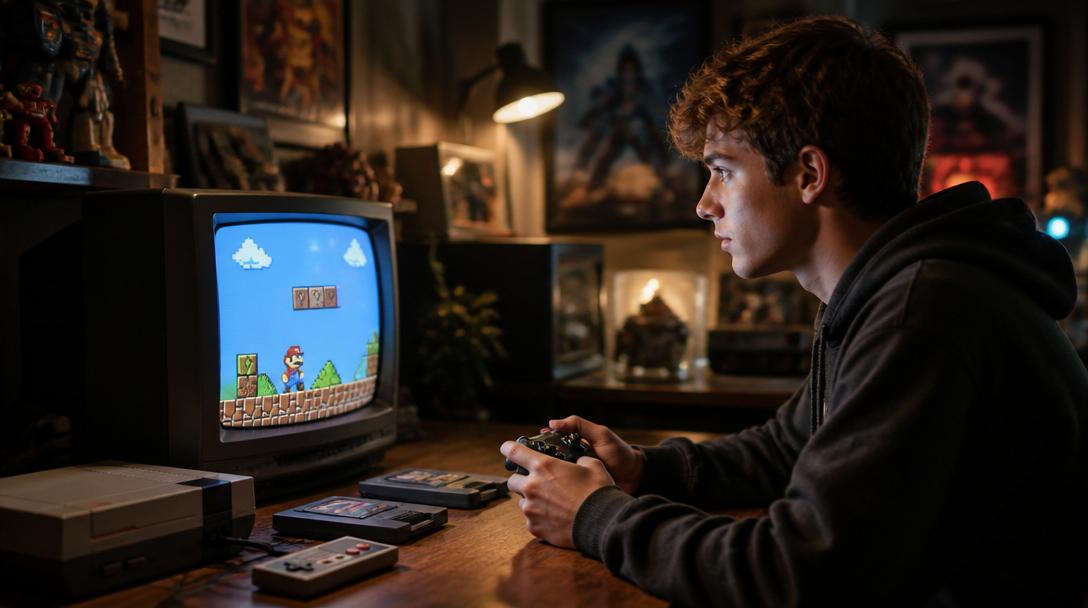
Consider Super Mario Bros., released in 1985 for the Nintendo Entertainment System. Its side-scrolling structure, tight controls, and carefully designed difficulty curve became a blueprint for platform games that followed, from Sonic the Hedgehog to modern indie hits such as Celeste. Players may now expect lush worlds and cinematic cutscenes, but the core lesson from Mario remains the same: a game can be memorable because movement feels good and every jump matters.
Then there is The Legend of Zelda, which helped popularize the idea of a vast adventure built around exploration rather than simple level progression. The original 1986 game gave players freedom, secrets, and a sense of discovery that still echoes through open-world design today. When modern games scatter hidden caves, optional quests, and collectibles across huge maps, they are not inventing a new formula so much as refining one that already worked on much smaller hardware.
Arcade games also deserve more credit than they usually get in trivia nights. Pac-Man, released in 1980, was not about shooting enemies or saving the universe; it was about pattern recognition, timing, and pressure that steadily increased as the maze filled with danger. That basic loop still appears in endless variations, from mobile puzzle games to survival titles that reward quick decisions and repeated attempts. Even the idea of chasing a high score, once central to arcade culture, still survives in competitive leaderboards and challenge runs.
Many modern players know Tetris only as a timeless puzzle, but its influence goes well beyond fitting blocks together. The game, created by Alexey Pajitnov in 1984, showed how elegant a simple rule set could be, and that lesson has never lost value. Today’s most successful casual games often rely on the same principle: easy to understand, difficult to master, and satisfying enough to make players say one more round. In that sense, Tetris is less a relic than a permanent design standard.
Retro trivia gets especially interesting when you look at genres that were still taking shape. Doom, released in 1993, did not invent the first-person shooter, but it made the genre a mainstream force with fast movement, maze-like levels, and intense combat. Many modern shooters still use ideas that Doom helped popularize, including keycard progression, multiplayer deathmatch, and mod-friendly communities. The game’s influence is so broad that it can be felt in everything from retro-inspired indie titles to the structure of major action franchises.
Fighting games offer another clear example of old ideas surviving in new forms. Street Fighter II, released in 1991, turned one-on-one competitive play into a cultural phenomenon by combining distinct characters, special moves, and deep timing-based strategy. Modern fighters may add online ranking systems, detailed training modes, and elaborate story content, but the heart of the experience still lies in reading an opponent and landing the right move at the right moment. Trivia fans who know the original roster often understand more about the genre than they first realize.
What makes the old and the new so closely linked is that technology changes faster than good design does. A contemporary game may offer motion capture, expansive voice acting, and sprawling worlds, yet it still depends on the same fundamentals that kept players returning to earlier classics: fair rules, clear goals, and satisfying feedback. That is why retro gaming trivia remains such a useful test of knowledge. It is not only about remembering the past, but about recognizing the DNA of the present.
There is also a cultural element to all this. Retro games have become shorthand for a time when players often learned by experimentation, manuals were precious, and secrets spread by word of mouth. Modern games may be easier to access, but they still reward curiosity in much the same way. Whether someone is replaying The Elder Scrolls V Skyrim, which drew on older role-playing traditions, or picking apart a pixel-art indie game that openly nods to the 8-bit era, the pleasure comes from seeing familiar ideas reworked with fresh tools.
That is what makes a gaming trivia quiz so satisfying. The best questions do not just ask who starred in a famous franchise or which console launched in which year. They reveal how a maze-chasing arcade hit, a side-scrolling platformer, or a top-down adventure still lives inside the games people play now, often without even noticing.