World History Trivia Across the Ages
The best world history questions do not simply reward memory. They reveal how a single battle, treaty or invention can alter the course of continents and still echo in daily life centuries later. A good quiz might ask which city was buried by the eruption of Mount Vesuvius, or which empire stretched from Britain to North Africa, but the real pleasure is in seeing the connections between those facts. When the answers start to click, history stops feeling like a long list and starts feeling like a story with consequences.
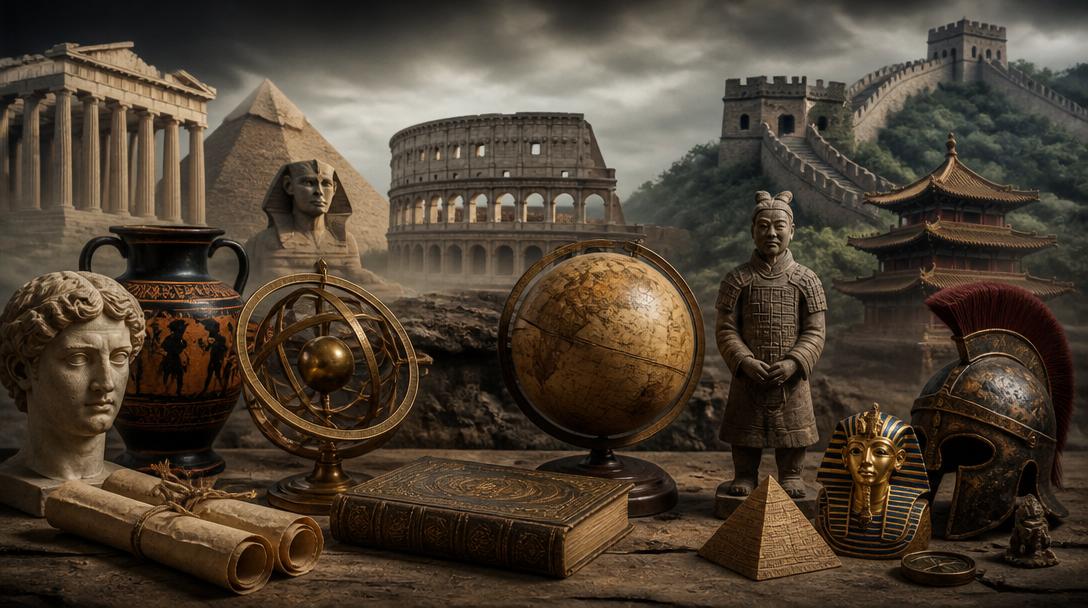
Some of the most compelling trivia comes from the ancient world, where the foundations of politics, law and science were laid in surprisingly familiar ways. Athens is remembered for early democracy, though it excluded women, enslaved people and foreigners from political participation. Rome gave the world roads, aqueducts and a legal tradition that still shapes modern systems, while Egypt’s pyramids remain a reminder of the administrative power needed to organise labour, materials and belief on a vast scale. Even a simple question about the Silk Road can open onto a bigger truth: long before airlines and shipping containers, goods, ideas and diseases were already travelling across Eurasia.
Medieval history often gets reduced to castles and knights, but trivia can bring out a far more global picture. The Abbasid Caliphate helped turn Baghdad into a major centre of learning, where scholars preserved and expanded works in mathematics, medicine and philosophy. In Song-dynasty China, innovations such as printing and the use of paper money changed how information and commerce moved through society. Meanwhile, in the Americas, the Maya developed sophisticated calendars and wrote in a complex script, while the Inca built a vast road network across the Andes without the wheel for transport. Questions that range across these civilisations are useful because they prevent history from becoming too Europe-centred.
The age of exploration is another favourite source of trivia, though it is often taught with too much emphasis on a handful of famous names. Christopher Columbus reached the Caribbean in 1492, but he was not the first human to cross the Atlantic, and his voyages were part of a much larger era of conquest, trade and forced migration. The Columbian Exchange transformed diets and populations on both sides of the ocean by moving crops, animals and pathogens between the Americas and the Old World. A quiz answer about potatoes or maize can therefore lead to a deeper understanding of why global history became truly global in the early modern period.
Revolutions are especially useful in trivia because they compress huge ideas into memorable dates and symbols. The French Revolution began in 1789 and reshaped politics far beyond France by challenging monarchy and privilege. The Haitian Revolution, which began in 1791, was even more radical in one essential respect: enslaved people successfully overthrew a slaveholding system and founded an independent republic. Such facts are not just impressive to recall; they remind us that political change has often come from people who were denied power by the very systems they overturned.
Industrial history offers another rich seam for quiz writers, because it links invention with everyday experience. The steam engine did not merely power factories; it helped transform transport, labour and the pace of life. Railways, telegraphs and mass production made distance feel smaller and time more disciplined, while also deepening inequality and environmental strain. A trivia question about the first public passenger railway or the first transatlantic telegraph cable may seem narrow, but it points to the moment when modern connectivity began to take shape.
World wars inevitably dominate many history quizzes because their scale and consequences were so immense. The First World War redrew borders and destabilised empires, while the Second World War accelerated technological change and led to the creation of the United Nations. The Holocaust remains one of the darkest subjects in human history and must never be treated lightly in quiz form, yet it is essential knowledge because it shows what can happen when state power, ideology and prejudice combine. Good trivia does not sensationalise such events; it helps ensure they are remembered accurately.
The appeal of world history trivia lies in the way it rewards curiosity without demanding perfection. You may know that Genghis Khan founded the Mongol Empire, that the fall of the Berlin Wall in 1989 symbolised the end of an era, or that the printing press is associated with Johannes Gutenberg, but each answer invites a larger question about cause and effect. That is what makes a well-made quiz satisfying: it is less about proving superiority than about recognising how deeply the past still lives inside the present.