The 1950s Pop Culture Quiz Challenge
The 1950s were a hinge decade, the moment when postwar optimism, new consumer habits and mass media began to shape popular culture in ways that still feel familiar today. Television moved from novelty to household fixture, rock and roll gave teenagers a sound of their own, and Hollywood learned how to sell glamour to a nation increasingly tuned into living rooms rather than cinema balconies. A quiz on the decade works best when it captures that mix of innocence and disruption, because the 1950s were never as simple as the pastel images suggest.
If you want to test your memory properly, start with the small details that became cultural landmarks. Elvis Presley’s rise was not just about the music, but about the shock of seeing a young performer bring rhythm and blues-inflected energy to a mainstream audience. His 1956 breakthrough with Heartbreak Hotel, followed by appearances that made parents nervous and teenagers ecstatic, helped turn rock and roll into a generational dividing line. At the same time, artists such as Chuck Berry, Little Richard and Buddy Holly were shaping the vocabulary of popular music, giving the decade its restless pulse and making the radio a battleground of taste.
Television changed the way Americans experienced celebrity, and a good quiz should lean into that transformation. Programs such as I Love Lucy, which began in 1951, became cultural events because they were not merely watched; they were discussed, quoted and imitated. Lucy Ricardo’s schemes, Desi Arnaz’s timing and the show’s pioneering use of filmed production turned it into a model for sitcoms that followed. Quiz questions about the era often work best when they connect stars to the format that made them household names, because the 1950s were the decade when the screen in the corner of the room started competing with the silver screen downtown.
Film also carried its own set of icons, though the mood was different from the swagger of rock music. Marilyn Monroe remained one of the decade’s most recognisable figures, with performances in films such as Gentlemen Prefer Blondes and The Seven Year Itch helping define a particular kind of movie-star glamour. James Dean, though his career was tragically brief, became a symbol of youthful rebellion after Rebel Without a Cause and East of Eden, while Audrey Hepburn brought a different sort of elegance to the screen in Roman Holiday and Sabrina. These names belong in any serious trivia journey because they reveal how the decade balanced polish, vulnerability and rebellion.
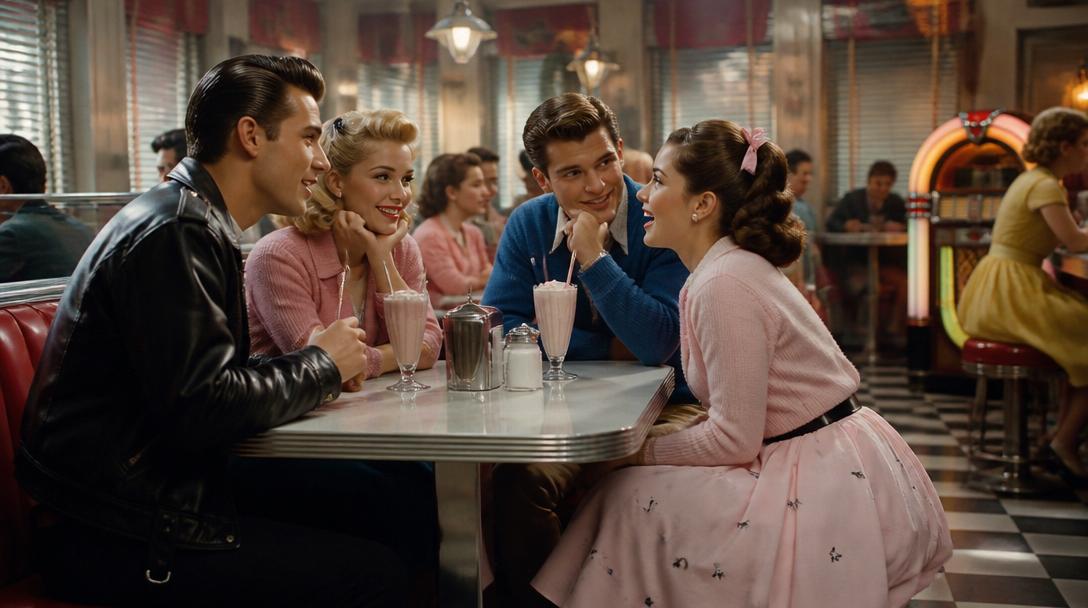
A strong 1950s quiz should also make room for the rise of consumer culture, because pop culture was not limited to songs and stars. Drive-in cinemas, diner culture, jukeboxes and comic books all contributed to an American landscape that felt newly branded and immediately recognisable. It was the era when teenagers became an identifiable market, and that mattered enormously to record companies, fashion sellers and advertisers. The look of the decade, from poodle skirts to leather jackets, was not simply clothing; it was part of a larger performance of identity.
The beauty of quizzing the 1950s is that the answers often open out into bigger stories. When you recall The Mickey Mouse Club, you are not just naming a children’s television show but remembering the early years of youth-targeted programming. When you think of Bill Haley and His Comets, you are hearing the sound of Rock Around the Clock and the way a song could become tied to a whole social shift. Even the era’s tabloid fascination with movie stars and scandal tells us something important: the modern celebrity machine was already taking shape, helped along by magazines, radio and television working in tandem.
For British readers, the decade has its own resonance too, because the 1950s were years when American pop culture crossed the Atlantic with increasing force. British audiences were watching the same films, hearing the same records and absorbing the same images, even as homegrown traditions remained strong. That cross-pollination would eventually feed the British Invasion of the 1960s, when musicians on this side of the Atlantic absorbed American rock and then sent it back with fresh force. In that sense, a 1950s quiz is not just nostalgia; it is a map of how modern global pop culture began to take shape.
What makes the decade so satisfying to revisit is that so many of its touchstones are still instantly recognisable. The silhouette of a jukebox, the image of a black-and-white television set, the sound of a doo-wop harmony or the swagger of a leather-clad rebel all remain part of our shared cultural memory. That is why the ultimate 1950s pop culture quiz works best as more than a test of recall. It becomes a way of tracing how the decade taught audiences to adore stars, chase trends and understand that entertainment could be both a private pleasure and a public obsession.