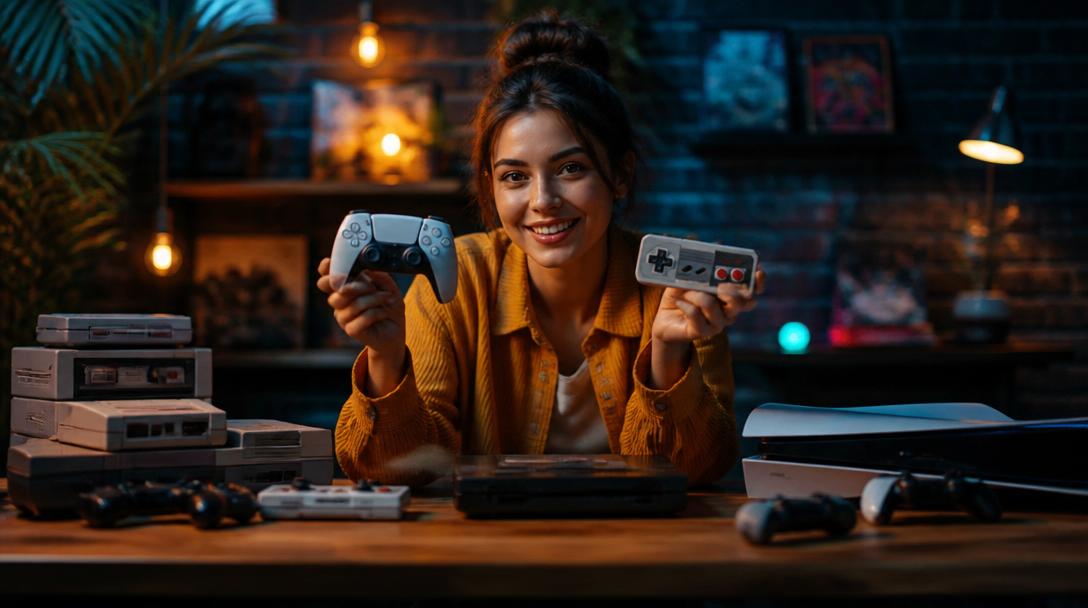
Retro and Modern Games in One Quiz
Ask a roomful of gamers what counts as retro, and the answers will probably reveal as much about age as taste. For some, it means the chunky pixels and bleeps of the 1980s, while for others it already includes the early 3D era of the PlayStation and Nintendo 64. That split is part of what makes gaming trivia so entertaining, because the same quiz can move from Space Invaders and Pac-Man to Minecraft and Elden Ring without ever losing its rhythm.
The earliest video game questions usually revolve around titles that defined the medium before most people thought of gaming as a serious pastime. Pong, released by Atari in 1972, is one of the easiest reference points because it helped turn electronic play into a commercial product. Arcade classics such as Space Invaders, Pac-Man and Donkey Kong mattered not only because they were popular, but because they established the idea of a recognisable game character, a clear objective and an immediate challenge. In trivia terms, they are useful because they sit at the crossroads of culture and history, which means the answer is often tied to more than just a title or a date.
Console history offers another rich seam for quizzes. The Nintendo Entertainment System, the Sega Mega Drive in Europe and the Super Nintendo all shaped the home gaming boom, and many questions focus on the franchises that became household names during that period. Super Mario Bros., The Legend of Zelda, Sonic the Hedgehog and Metroid are not merely games from the past; they are enduring brands that still appear in new releases, remakes and spin-offs. That continuity makes them especially tricky in trivia, because a player may know the modern version of a series without remembering where it began.
Modern gaming questions work differently. Instead of asking only who starred in a game or which company released it, quizzes now often draw on mechanics, platforms and online communities. Minecraft is a good example because its identity is defined as much by creative building and user-generated worlds as by any traditional storyline. Fortnite, meanwhile, is often recognised less for a single campaign than for its battle royale format, live events and constantly changing seasonal content. In a quiz setting, that means the most revealing question may not be about a character at all, but about how a game is played and why it became a phenomenon.
One of the most interesting shifts in gaming trivia is the move from fixed releases to games that keep evolving after launch. Older titles were largely finished products, which made their trivia neat and self-contained. Today’s major games may receive downloadable content, balance updates and expansions long after they first appear, so a question can quickly become a test of whether the player remembers launch details or later changes. That is particularly true of online games and competitive titles, where maps, modes and seasonal updates can reshape the experience without changing the name on the box.
The hardware side of gaming also gives trivia its bite. Retro questions often rely on remembering which system launched a game or which controller introduced a certain feature, while modern questions can involve the rise of high-definition graphics, motion controls, virtual reality or cross-platform play. The Nintendo Wii, for example, became famous for its motion-sensitive controller, while the Switch blurred the line between handheld and home console gaming. These are not just technical details; they help explain why certain games became famous in the first place.
Trivia also reveals how gaming has moved from a niche hobby into a global entertainment industry. In the arcade era, knowledge tended to centre on high scores, cabinet machines and local competition. In the modern era, players are just as likely to know games through streaming, esports, speedrunning or social media clips. A person might recognise The Last of Us from its television adaptation and then work backwards to the game itself, or know about Grand Theft Auto through headlines without having played it. That wider cultural footprint means quiz questions can now draw on gaming’s place in film, TV and online culture as much as on gameplay alone.
The best gaming quizzes balance nostalgia with the present tense. A question about Tetris can test whether someone knows that the puzzle game was created by Alexey Pajitnov in the Soviet Union, but it can also lead into a discussion of how the game has survived across handhelds, phones and consoles for decades. A question about The Legend of Zelda can start with the original NES release and end with the open-world scale of Breath of the Wild or Tears of the Kingdom. That range is what makes the topic so satisfying: every answer opens a door to a different era, and every era has its own logic.
What keeps players coming back is not just the bragging rights, but the pleasure of recognition. A good trivia quiz rewards the person who remembers the sound of an 8-bit start-up screen and the person who can identify a modern blockbuster by its mechanics alone. Retro and modern games may look very different, yet they share the same basic appeal of mastery, discovery and play. In the end, that is why gaming trivia works so well: it is both a memory test and a history lesson, wrapped inside a pastime that never really stops changing.