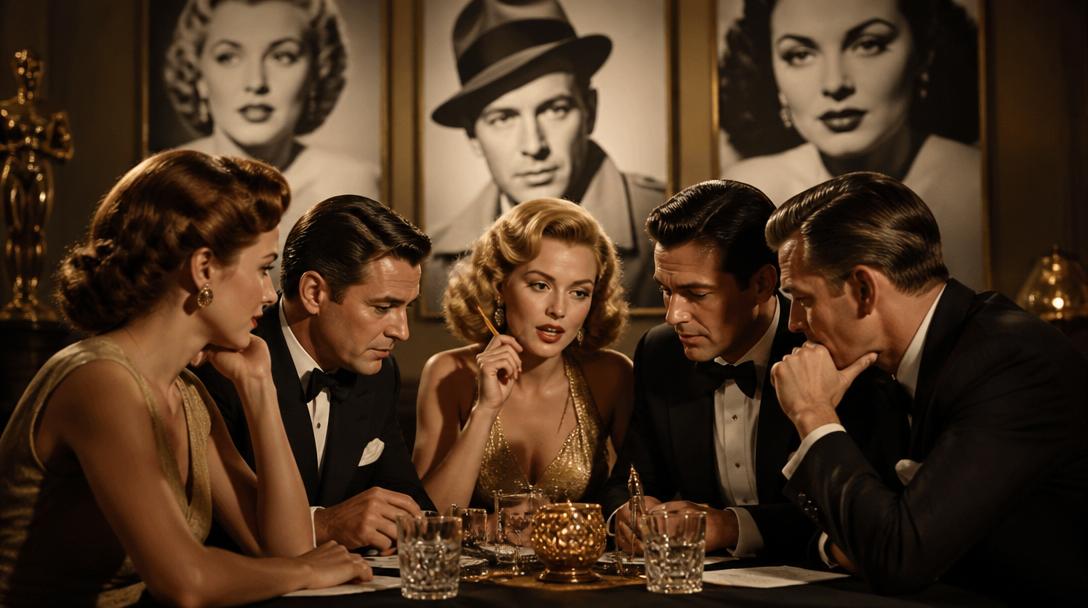
Hollywood Golden Age on the Quiz Table
The phrase “Golden Age of Hollywood” usually points to the studio era that stretched from the late 1920s through the 1950s, when the major studios controlled production, promotion, and in many cases the public image of their stars. It was the age of lavish premieres, fixed genres, and glamorous publicity stills that helped turn actors into legends. A nostalgia quiz about this era works so well because it taps into more than film history; it reaches into family memories, afternoon television, and the special thrill of seeing black-and-white icons behave as if they were made for eternity.
What makes the period so endlessly quiz-worthy is how distinct it looks and feels. The studios had their own identities, from MGM’s polished prestige to Warner Bros.’ tough-edged urban dramas, and audiences came to expect a certain style from each one. That makes the era easier to recognize than many later decades, because the films were built around clear stars, strong genres, and memorable visual signatures. Even now, people who have never seen a full run of classic films can often identify the vibe of a Fred Astaire and Ginger Rogers musical, a Humphrey Bogart crime story, or a Technicolor swashbuckler just from a few images or a single song.
A good quiz on this subject usually starts with the names that still carry instant recognition. Clark Gable, Katharine Hepburn, Bette Davis, Cary Grant, Ingrid Bergman, Judy Garland, and Audrey Hepburn are all part of the era’s long afterlife, each linked to roles that helped define screen acting for generations. The challenge is that many of these stars became famous for more than one kind of film, which is why trivia fans need to know the difference between a signature performance and a later comeback. If you remember that Casablanca was released in 1942, that Gone with the Wind arrived in 1939, and that Singin’ in the Rain premiered in 1952, you are already tracing the arc of the studio years with some accuracy.
The Golden Age also lingers because so many of its films became part of everyday language. Lines from The Wizard of Oz, The Maltese Falcon, and Gone with the Wind are quoted so often that even people who have not sat through the whole movie know the rhythm of them. The same is true of unforgettable scenes, such as the shower sequence in Psycho from 1960, which sits right on the edge of the classic era and shows how quickly Hollywood was changing by then. Trivia questions often lean on these landmark moments because they are easier to remember than plot details, yet they still test whether the viewer has a real sense of the period.
Another reason this era fuels nostalgia is the craft behind it. Studio-era films were built on tightly controlled lighting, elaborate sets, and a kind of old-fashioned polish that modern viewers often notice immediately. Color films such as The Adventures of Robin Hood and The Wizard of Oz became famous for showing what Hollywood could do when it wanted to dazzle, while black-and-white dramas used shadow and composition to create mood in ways that still feel elegant. In a quiz setting, this gives room for questions about cinematography, costume design, and even which films helped popularise certain visual styles.
The musical is one of the richest corners of any Golden Age quiz because it combines star power with spectacle. Gene Kelly, Astaire, Garland, and others made singing and dancing feel effortless, even when the productions behind them were meticulously planned. Whether it is the rain-soaked joy of Singin’ in the Rain or the romantic glide of Top Hat, these films remind viewers that classic Hollywood often aimed to transport rather than merely entertain. That sense of escape is one reason they remain so beloved, especially for people who grew up seeing them on television or in revival cinemas.
There is also a quieter appeal in the supporting players and character actors who filled out the studio system. People like Edward G. Robinson, Claude Rains, Joan Blondell, and Thelma Ritter helped create the texture of classic Hollywood, giving films a sense of lived-in credibility. A well-made trivia quiz will not only ask about the biggest names but also reward those who remember the faces in the margins, because the era was built on ensemble craftsmanship as much as on stardom. That is part of the fun: the more you know, the more the whole machinery of the period comes into view.
What keeps the Golden Age alive is that it offers a complete world, one with its own manners, rhythms, and dreams. The clothes are sharper, the dialogue is cleaner, and the dramas often feel more theatrical than modern films, but that is exactly why they endure. For many people, revisiting this period is less about historical distance than about rediscovering a time when Hollywood seemed to understand glamour as a language all its own, and when a single close-up could make the audience believe in forever.