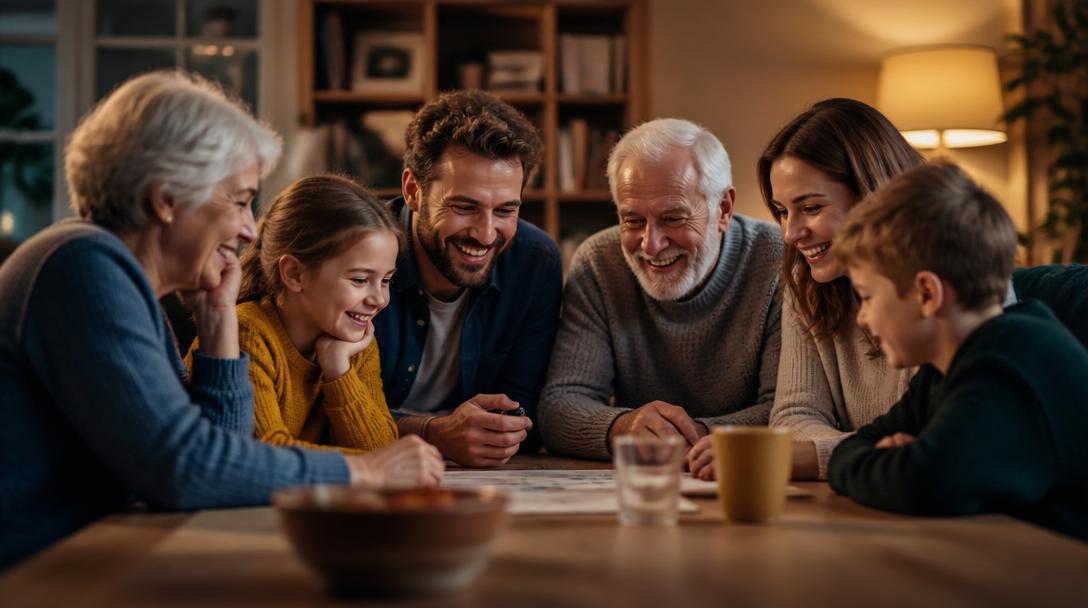
Family Quiz Night Across the Generations
The secret to a successful family trivia night is not difficulty, but balance. A brilliant quiz should give a seven-year-old a chance to shine on animals or cartoons while also letting a grandparent steal the round with a question about old films, geography or classic songs. When everyone feels useful, the whole room stays engaged, and the evening becomes less about winning than about shared momentum and easy conversation.
That is why the most effective family quizzes mix subjects rather than clustering them by school knowledge alone. A round on flags can sit alongside a round on breakfast foods, famous landmarks or household objects, because general knowledge works best when it touches everyday life. Children often surprise adults with what they know from books, games and streaming shows, while adults may be quickest on history, sport or the names of long-running TV characters. The fun lies in those handovers, when one generation carries a team for a while and then another steps in.
The format matters as much as the questions. Short rounds keep younger players from drifting off, and a mix of easy and moderate questions prevents the game from feeling like homework. Picture cards, sound clues and picture rounds can make a big difference for mixed ages, since not every child is equally confident with reading, and not every adult wants a quiz that feels like an exam. A family night works best when the clues are clear enough to be fair but open enough to spark debate, because a good argument over the answer is often part of the entertainment.
One useful approach is to build the quiz around shared experiences. Questions about food, weather, holidays, pets, school subjects, toys, transport and famous places can prompt stories as well as answers. A question about the highest mountain in the United States may lead to a child remembering a class project, while a question about the inventor of the light bulb can open a discussion about how people learned things before the internet. Trivia becomes richer when it creates a bridge between fact and memory.
It also helps to avoid making the evening too dependent on one type of knowledge. A family with keen readers may race through literature questions, while another household might be stronger on music, film or sports. The fairest quizzes spread the spotlight around, so no one group dominates from start to finish. That variety is especially useful if younger children are involved, because it keeps the game from becoming predictable and gives every player a reason to stay in the room.
Another strength of family trivia is that it can be tuned to the moment. During the winter holidays, questions about seasonal traditions, reindeer, lights and festive food can create a warm atmosphere. On a rainy weekend, a round about board games, indoor hobbies or famous inventors can fit the mood just as well. The theme does not need to be elaborate; even a simple round on “things found in the kitchen” can become memorable when someone argues passionately for the difference between a whisk and a spatula.
For households that enjoy a bit of competition, scoring can be kept simple. A point per correct answer is enough, though some families prefer bonus points for teamwork or for answering a hard question after a wrong guess. Others skip formal scoring entirely and treat the quiz as a game of shared challenges, with the prize being first choice of dessert or the right to pick the next film. The point is not to build tension, but to give the evening a shape that keeps everyone involved.
The best family trivia nights often become traditions because they are easy to repeat and easy to adapt. One week the questions might come from a deck of cards or a printed sheet, and the next they might be read aloud from a phone while everyone shouts guesses from the sofa. As the years go on, the same family will often begin to collect its own private references, with questions about old holidays, school events and memorable mishaps that no outside quiz could ever capture. That is where the real appeal sits: not just in knowing the answer, but in sharing the story that comes with it.